Ancestral Futures: How Digital Tools Are Saving Latin American Folk Traditions From Disappearing Forever
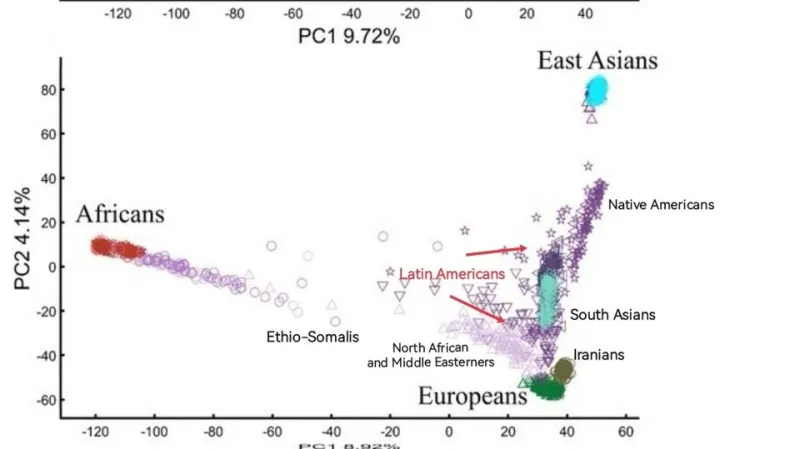
Photo: Based on improved results by Eran Elhaik 2022 (fixed PCA results by improved sampling numbers and reference sources), CC BY-SA 4.0, via Wikimedia Commons
The Urgency Beneath the Algorithm
In a small studio in Oaxaca, a twenty-four-year-old textile artist named Valeria photographs each stage of a backstrap loom weaving her grandmother taught her, uploading the documentation to an online archive that receives visitors from forty countries. In Miami, a second-generation Cuban American musician records his father playing a son cubano pattern on tres guitar — not for an album, but for a digital repository maintained by a university library. In Los Angeles, a nonprofit digitizes hundreds of hand-embroidered huipiles before their elderly creators pass on, creating high-resolution records of garments that took months to produce and carry cosmological meaning in every stitch.
These efforts, dispersed across geography and methodology, share a common urgency: the recognition that certain forms of Latin American cultural knowledge exist in the bodies and memories of a diminishing number of practitioners, and that without deliberate intervention, they will not survive the generation currently living. The Rigo Camerano Cultural Foundation has tracked this crisis — and the creative responses to it — for years, observing with both concern and cautious optimism the ways in which digital technology is being conscripted into the service of cultural memory.
What Is Actually at Stake
Before examining the solutions, it is worth dwelling on the scale of the problem. UNESCO estimates that roughly half of the world's languages will disappear by the end of this century, and with each language goes an irreplaceable system of knowledge — including artistic traditions that have no adequate translation into Spanish, English, or any dominant tongue. Across Latin America, Indigenous weaving patterns encode astronomical calendars, genealogical records, and spiritual cosmologies that exist nowhere else. Certain percussion traditions in Afro-Caribbean communities carry the encoded memory of enslaved ancestors who were forbidden from speaking their languages openly. When these practices cease, the loss is not merely aesthetic. It is epistemic.
The challenge facing preservationists is not simply one of documentation, however. Recording a tradition is not the same as sustaining it. Archives, however meticulously assembled, do not guarantee that a practice remains living — that it continues to be made, used, taught, and transformed by communities who find it meaningful. This distinction between preservation and revitalization is central to the most thoughtful work being done in this field.
The Digital Archivists Rebuilding the Record
Several institutions deserve recognition for the sophistication of their digital preservation initiatives. The Library of Congress's American Folklife Center has expanded its Latin American holdings in recent years, partnering with community organizations to collect field recordings, photographic documentation, and oral histories that would otherwise exist only in private memory. The Smithsonian's Center for Folklife and Cultural Heritage has similarly invested in digital platforms that make its collections accessible to researchers, educators, and community members who may have no practical means of traveling to Washington, D.C.
Independent efforts are equally compelling. Organizations operating outside the institutional mainstream — often founded by members of the communities whose heritage they document — have developed nimble, community-accountable approaches to digital archiving. Rather than centralizing collections in distant repositories, some of these groups are building locally controlled digital libraries that keep cultural materials within the communities that produced them, accessible on the terms those communities define.
The technical tools available to these archivists have expanded considerably. Three-dimensional scanning now allows for the creation of detailed digital models of textiles, ceramics, and ritual objects, capturing not only surface appearance but structural information about construction techniques. Audio restoration software is recovering recordings of musical performances previously considered too degraded to transcribe. Photogrammetry is generating navigable virtual reconstructions of ceremonial spaces. The technology, in other words, is no longer the limiting factor. The constraints are financial, institutional, and political.
Generation Z as Cultural Intermediary
Perhaps the most surprising development in this landscape is the role that young people — particularly members of the diaspora — are playing not merely as consumers of preserved heritage but as active agents of its revitalization. Across social media platforms, a growing number of creators in their teens and twenties are producing content that introduces ancestral practices to audiences who would never encounter them through conventional cultural institutions.
On YouTube and Instagram, young Peruvian Americans are documenting their grandparents' knowledge of traditional dyeing techniques using natural pigments. On TikTok, creators from Mexican American communities are teaching the basics of son jarocho guitar and zapateado footwork to followers who number in the hundreds of thousands. These are not academic presentations; they are personal, often emotionally raw explorations of inherited identity, filtered through the visual grammar of contemporary digital media.
The Rigo Camerano Cultural Foundation views this phenomenon with genuine enthusiasm, while also noting its complexities. The algorithmic incentives of social media platforms do not always align with the requirements of careful cultural transmission. A thirty-second video can spark interest but cannot convey the years of embodied practice required to truly learn a traditional art form. The risk of decontextualization — of reducing a sacred weaving pattern to a trending aesthetic, or a ceremonial musical form to a catchy audio clip — is real and merits ongoing attention from cultural educators and community leaders.
Yet the countervailing evidence is equally real. Several young creators who began their journeys on social media have subsequently pursued formal apprenticeships with master artisans, enrolled in Indigenous language programs, or established community workshops that teach traditional skills to peers. The digital introduction, however superficial its initial form, has in many cases served as a genuine threshold.
Remixing Without Erasing: The New Cultural Synthesis
Among the most intellectually generative questions in contemporary cultural preservation is whether traditional practices can be meaningfully adapted — remixed, fused, recontextualized — without losing their integrity. This question is not new; every living tradition has always evolved through contact with other traditions and changing social conditions. What is new is the speed and scale at which those contacts now occur.
Young artists working at the intersection of heritage and innovation are producing responses to this question that resist easy categorization. Textile artists are incorporating traditional Andean patterns into contemporary fashion designs while insisting on full transparency about their sources and collaborating financially with the communities from which those patterns originate. Musicians are layering Indigenous melodic forms over electronic production while crediting their influences and donating portions of their revenue to cultural preservation funds. These are not perfect solutions — the ethical complexities of cultural borrowing do not yield to tidy resolution — but they represent a serious and ongoing engagement with the responsibilities that come with inheriting a tradition.
Stewardship as an Act of Love
The Rigo Camerano Cultural Foundation was established on the conviction that Latin American artistic heritage is not a relic to be preserved under glass but a living inheritance to be actively tended. The digital revolution, for all the disruption it has introduced into cultural life, has also placed extraordinary tools in the hands of those who share that conviction.
What those tools require, above all, is the human commitment to use them wisely — with respect for the communities whose knowledge is being documented, with humility about the limits of technological solutions, and with the long-term perspective that genuine cultural stewardship demands. The ancestors whose art forms we are working to protect made those works with patience, with skill acquired over lifetimes, and with a deep sense of obligation to those who would come after them.
We owe them, and each other, nothing less.
