Unseen Architects: The Latin American Production Designers Who Built American Television's Visual Identity
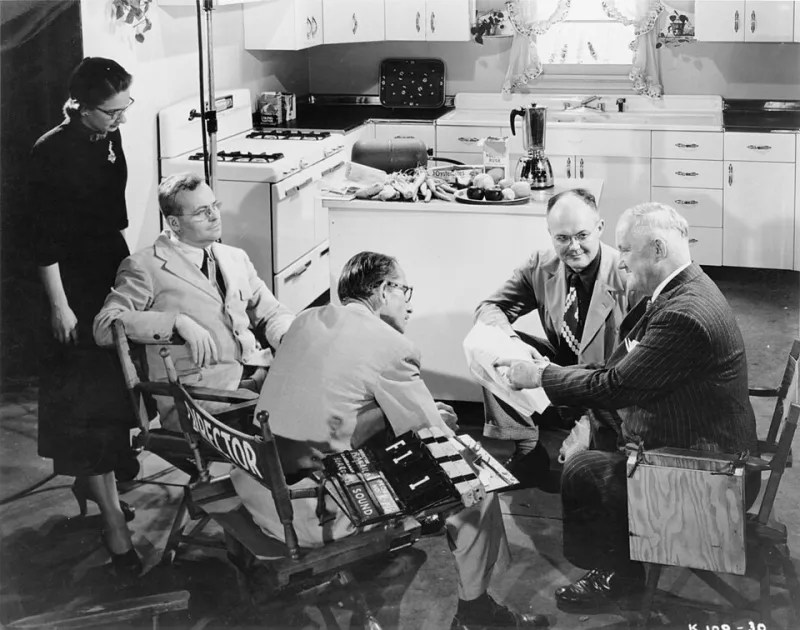
Photo: This studio production photo was taken by a photographer working for Ray and Betty Culley, owners of Cinécraft Productions, a Cleveland, Ohio motion picture studio, in 1949., CC BY-SA 2.5, via Wikimedia Commons
When American audiences settled into their living rooms to watch the sprawling domestic dramas and prestige productions that defined decades of network and cable television, they were, in many cases, inhabiting visual worlds constructed by Latin American artists. The warm ochre tones of a fictional Southwest household, the carefully layered symbolism embedded in a character's personal space, the way a corridor's geometry telegraphed psychological tension before a single line of dialogue was spoken — these choices were frequently the work of production designers and art directors whose heritage, training, and sensibility were rooted in Latin American artistic traditions. Yet their names, if they appeared at all, scrolled past in type too small for most viewers to register.
The story of Latin American influence on American television's visual grammar is, at its core, a story about erasure — and, increasingly, about reclamation.
A Tradition of Spatial Storytelling
Latin American artistic culture has long approached space as a narrative instrument. From the sweeping muralist movements of Mexico, which treated walls as storytelling surfaces, to the theatrical architectural traditions of Argentina and Brazil, there exists a deeply embedded understanding that environment communicates meaning with the same urgency as spoken language. When designers trained within these traditions entered American television production — often through circuitous paths involving migration, reinvention, and professional compromise — they brought this sensibility with them.
The results were frequently transformative. Production designers from Mexico, Venezuela, Colombia, and Argentina introduced approaches to color that departed from the neutral, "invisible" palettes favored by conventional American television aesthetics of the 1970s and 1980s. Where the dominant industry tendency was to render domestic interiors as unobtrusive backdrops, these designers understood that color carried psychological and cultural weight. A particular shade of terracotta was not merely decorative; it evoked lineage, warmth, and the specific quality of late-afternoon light in a city far from Los Angeles or New York. These choices resonated with audiences even when — perhaps especially when — viewers could not articulate precisely why a scene felt emotionally immediate.
Soap Operas as Laboratories of Influence
American daytime soap operas, long dismissed as a lowbrow genre unworthy of serious aesthetic analysis, were in fact remarkable proving grounds for visual innovation. The genre's relentless production schedule — episodes shot and broadcast with a speed that would alarm most prestige drama crews — demanded designers who could work with extraordinary efficiency while still producing environments capable of sustaining viewer engagement across years and even decades.
Several Latin American production designers found their footing in this demanding format. The genre's requirements aligned unexpectedly well with a tradition of resourceful artistry: the ability to generate maximum visual impact from limited materials, to use symbolic objects and color relationships to communicate character psychology without expository dialogue, and to create spaces that felt simultaneously aspirational and emotionally accessible. Techniques that had been refined in telenovela production across Latin America — where set design had long been understood as a primary storytelling tool rather than a secondary craft — translated with startling effectiveness into the American daytime context.
Yet when these productions earned industry recognition, the designers behind their visual environments were rarely among those called to the stage. The cultural and institutional structures of the American television industry were not designed to surface the contributions of those who worked behind the camera, and they were especially ill-equipped to recognize artistry that arrived from outside the established Anglo-American design tradition.
Prestige Drama and the Mainstreaming of Borrowed Aesthetics
As American television entered its celebrated "golden age" of prestige drama in the late 1990s and 2000s, the visual sophistication that Latin American designers had helped introduce into the medium became increasingly legible to critics and awards bodies — even as its origins remained obscured. The rich, layered approach to environmental storytelling that distinguished many of the era's most acclaimed productions owed a debt that was rarely, if ever, publicly acknowledged.
The pattern is familiar from other creative industries: a marginalized tradition contributes foundational innovations to a mainstream form, those innovations are absorbed and normalized, and the process of normalization conveniently severs the connection to their source. What had once been recognizable as a distinct aesthetic sensibility — rooted in specific cultural experiences and artistic lineages — became simply "good television design," a standard against which future work would be measured without reference to who had established it.
For the Latin American designers who had helped build that standard, the experience was often one of profound ambivalence. Professional success within the American industry frequently required a degree of self-effacement, a willingness to allow one's cultural perspective to inform the work invisibly rather than explicitly. Those who attempted to foreground their heritage risked being categorized as specialists suitable only for productions with explicit Latin American content — a limiting and reductive assignment that many resisted even as they chafed against the alternative.
Why the Erasure Persists
Understanding why this pattern of non-attribution has proven so durable requires confronting some uncomfortable realities about how the American entertainment industry constructs and maintains hierarchies of creative credit. Production design, as a discipline, occupies an ambiguous position in the industry's prestige economy: acknowledged as essential to the final product, yet rarely elevated to the same cultural visibility as directing, writing, or lead performance. This structural undervaluation is compounded, for Latin American designers, by the persistent tendency to regard their contributions as culturally specific rather than universally applicable — a misreading that conveniently justifies their exclusion from broader conversations about the medium's artistic development.
There is also the question of documentation. The institutional archives that might preserve detailed records of individual creative contributions to major productions have not always been maintained with equity or comprehensiveness. When the Rigo Camerano Cultural Foundation considers the importance of preserving Latin American artistic legacies, the challenge of recovering this particular history — dispersed across decades of production records, personal archives, and the memories of aging practitioners — illustrates precisely why such preservation work is urgent.
A Generation Demanding Its Place in the Record
Contemporary Latin American production designers working in American television are navigating this history with a mixture of clear-eyed pragmatism and active resistance. Many are engaging directly with questions of attribution and cultural acknowledgment in ways their predecessors were rarely positioned to do. Professional organizations, academic researchers, and cultural institutions are beginning to compile the kind of documented record that can support a more accurate account of the medium's visual history.
Some designers are also using their current platform to create explicit connections between their work and the traditions that inform it — naming their influences publicly, discussing the cultural logic behind their aesthetic choices in interviews and panels, and mentoring younger practitioners in ways that transmit not only technical knowledge but cultural context. This is, in its way, an act of archival defiance: the creation of a living record that institutional neglect failed to produce.
The visual language of American television was not invented in a vacuum. It was built, in substantial measure, by artists whose names deserve to be spoken alongside the productions they shaped. Recovering that history is not merely an act of belated justice — it is a necessary correction to the record of a medium that has shaped American culture for generations. The foundation's commitment to preserving and illuminating Latin American artistic contributions finds, in this particular history, one of its most compelling and consequential subjects.