The Long Way Home: Why Latin American Artists Must Cross a Border to Reclaim Their Own Traditions
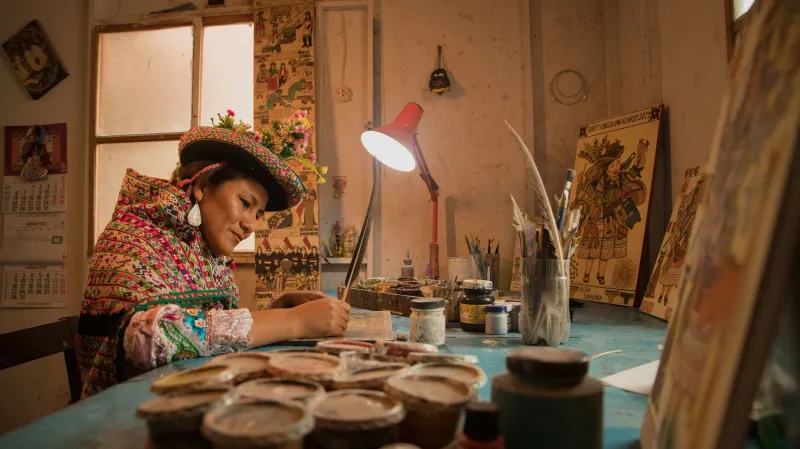
There is a quiet irony embedded in the story of Valentina Ríos, a textile artist from Oaxaca who spent two years apprenticing in a Los Angeles studio before she felt she truly understood the weaving traditions of her own grandmother. The loom techniques, the dyeing vocabulary, the ceremonial grammar encoded in pattern and color—she encountered all of it with new clarity not in Mexico, but in a Boyle Heights workshop run by a collective of Zapotec weavers who had settled in Southern California decades before she was born. "In Oaxaca," she has said, "tradition is everywhere, so it becomes invisible. Here, it is something people had to fight to keep. That changes how you see it."
Ríos is not alone in this experience. Across the United States, a counterintuitive migration pattern has emerged among artists from Mexico, Colombia, Peru, Guatemala, and beyond. Rather than traveling to European capitals in search of formal training or cosmopolitan exposure, a significant number of contemporary Latin American artists are relocating to American cities—Los Angeles, Chicago, Miami, Houston, New York—specifically to deepen their engagement with the cultural traditions of their own homelands. The destination is not the art school or the gallery district. It is the diaspora.
When Preservation Happens in Exile
The phenomenon is not entirely new, but its current scale and self-consciousness are. For generations, immigrant communities in the United States have maintained cultural practices—music, craft, cuisine, ceremony, oral tradition—with a fidelity that can exceed what survives in the places of origin. Displacement, paradoxically, can intensify cultural commitment. When a tradition is no longer ambient, when it cannot simply be absorbed through proximity, it must be actively chosen and deliberately transmitted. The result, in many diaspora communities, is a form of preservation that is simultaneously conservative and creative: faithful to inherited forms while constantly negotiating their meaning in a new context.
What has changed in recent years is that artists from Latin America are beginning to recognize these diaspora communities not merely as nostalgic repositories but as living laboratories of cultural practice. The Mariachi musicians of East Los Angeles, the Andean flutists performing in Jackson Heights, the Afro-Colombian drummers teaching in Atlanta—these are not simply immigrants maintaining a connection to the past. They are, in many cases, custodians of techniques and knowledge that have been attenuated or commercialized in their countries of origin.
The Domestic Market Problem
Understanding why artists leave requires understanding what they leave behind. In many Latin American countries, the market pressures on traditional art forms are severe. Folk crafts are scaled up for tourist consumption, their complexity simplified and their symbolic content diluted. Indigenous musical traditions are folded into national branding campaigns that celebrate their surface while ignoring their depth. Young artists who wish to engage seriously with ancestral practices often find that the domestic art world regards such engagement as retrograde—an obstacle to the kind of contemporary relevance that attracts international attention and institutional support.
The United States, for all its own complications around cultural appropriation and immigrant identity, offers something different: communities where traditional practice is embedded in daily life rather than displayed for external audiences, and where the transmission of artistic knowledge carries genuine social weight. A young Colombian ceramicist who arrives in Chicago and finds her way into a community of potters from Ráquira may discover that her hosts possess technical knowledge unavailable in any formal institution—knowledge kept alive precisely because the community needed it, not because any government or foundation decided it was worth preserving.
Mentorship Networks and the Architecture of Transmission
The mentorship structures that have developed within Latin American diaspora communities in the United States are, by most measures, extraordinary. They operate largely outside institutional frameworks—outside universities, arts councils, and cultural agencies—sustained instead by personal relationships, community obligation, and the recognition that certain knowledge will disappear if it is not actively passed on.
For artists arriving from Latin America, gaining access to these networks is rarely straightforward. Trust must be established. Community ties must be demonstrated or gradually built. The artist must be willing to learn as a student rather than arrive as a credentialed practitioner. But those who navigate this process successfully often describe the experience as transformative in ways that formal training cannot replicate. They are not studying a tradition from a scholarly distance. They are being inducted into a living practice by people for whom that practice is inseparable from identity and survival.
This is the paradox that gives the migration pattern its particular character. The artists who make this journey are, in a meaningful sense, going home—not to a geographic place but to a form of cultural intimacy that their home countries, for various historical and economic reasons, have struggled to sustain.
Innovation at the Intersection
It would be a mistake to characterize this movement as purely backward-looking. The artists who engage most deeply with diaspora communities are not seeking to reproduce ancestral forms unchanged. They are seeking the foundational knowledge that makes genuine innovation possible—the difference between an artist who experiments with traditional form from a position of understanding and one who appropriates surface elements without comprehending their logic.
The work that emerges from these encounters is often striking in its combination of rigor and freshness. Painters who have spent years learning the pigment traditions of Mesoamerican muralism bring that knowledge to canvases that address entirely contemporary subjects. Dancers trained in Afro-Latin movement vocabularies by community elders in Miami or New York develop choreographic languages that are unmistakably rooted yet formally innovative. The tradition does not constrain the work; it authorizes it.
This dynamic has not gone unnoticed by American cultural institutions, which are increasingly looking to diaspora communities—and to the artists who have found their way into them—as sources of both artistic vitality and cultural authority. The challenge, as ever, is whether institutional attention will support these communities on their own terms or gradually reshape them to serve external purposes.
What the Journey Reveals
The artists who have made this counterintuitive migration tend to speak of it in terms that go beyond professional development. They describe a reorientation of identity, a renegotiation of their relationship to heritage, and a deepened understanding of what it means to practice art as a form of cultural responsibility rather than individual expression.
For the Rigo Camerano Cultural Foundation, the significance of this pattern extends beyond any individual artist's trajectory. It points toward a broader truth about how Latin American artistic traditions survive and evolve: not always through the institutions designed to protect them, and not always within the borders of the nations that claim them, but through the sustained commitment of communities that have chosen, sometimes under difficult circumstances, to carry those traditions forward. The long way home, it turns out, sometimes leads through someone else's city—and arrives somewhere more genuine than the place of departure.